
Western Cape Entrepreneurship Impact Fund 2026: Apply for Business Development Funding of R500,000 and Above

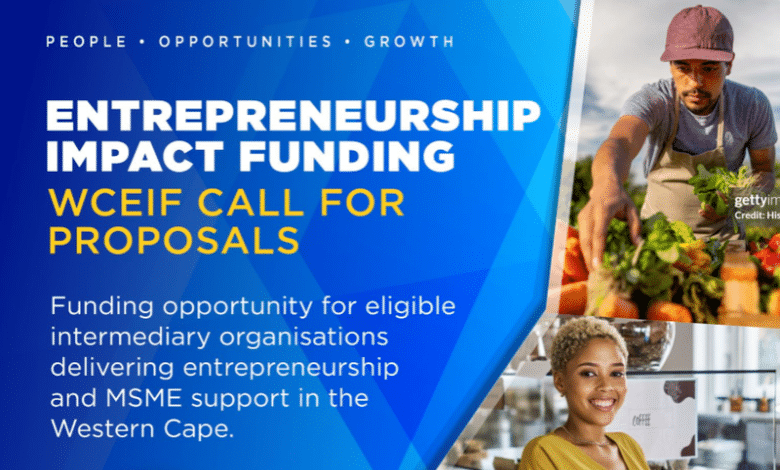
Western Cape Entrepreneurship Impact Fund 2026: Apply for Business Development Funding of R500,000 and Above
The Western Cape Government, through its Department of Economic Development and Tourism (DEDAT), is inviting eligible organisations to apply for funding through the Western Cape Entrepreneurship Impact Fund (WCEIF).
The fund is designed to strengthen entrepreneurship, support Micro, Small and Medium Enterprises (MSMEs), improve business growth and create employment opportunities across the Western Cape.
Unlike conventional business grants that provide money directly to individual entrepreneurs, the WCEIF follows an outcomes-based co-funding model. It supports organisations that design and implement programmes, projects and interventions aimed at helping entrepreneurs and businesses become more competitive, sustainable and successful.
Eligible applicants may include registered companies, non-profit organisations, trusts, universities, TVET colleges, industry associations, business chambers, municipalities and other organisations involved in entrepreneurship and enterprise development.
The minimum funding request is R500,000, with the Department of Economic Development and Tourism contributing between 20% and 50% of the total project value.
Applications opened on 14 October 2026 and remain open subject to budget availability.
About the Western Cape Entrepreneurship Impact Fund
The Western Cape Entrepreneurship Impact Fund is an outcomes-based funding initiative established by the Western Cape Department of Economic Development and Tourism.
The fund aims to strengthen the entrepreneurial ecosystem by supporting organisations that develop and implement interventions benefiting entrepreneurs and MSMEs.
The initiative recognises that entrepreneurs and small businesses play an important role in economic development, innovation and job creation. However, many businesses continue to experience challenges that limit their ability to establish, grow and remain sustainable.
Some of the challenges the fund seeks to address include:
- Limited access to appropriate business finance and investment.
- Difficulty accessing markets and procurement opportunities.
- Weak coordination between entrepreneurship support organisations.
- Limited business development support in rural and township communities.
- High business failure and discontinuation rates.
- Insufficient access to business networks, mentorship and technical assistance.
- Limited adoption of technology and innovation by small businesses.
Through the WCEIF, the Western Cape Government seeks to work with organisations that can develop practical interventions addressing these challenges and demonstrate measurable economic and developmental outcomes.
How Much Funding Is Available?
The WCEIF operates through a co-funding arrangement between the Department of Economic Development and Tourism and the successful applicant.
The department will contribute between 20% and 50% of the total project value, at its discretion.
The applicant must provide the remaining contribution.
The applicant’s contribution may include:
- Cash contributions.
- Third-party funding.
- Approved in-kind contributions.
The department determines the eligibility and value of proposed in-kind contributions.
Minimum Funding Request
The minimum funding request under the programme is:
R500,000.
Applications requesting less than R500,000 will not be considered.
There is no fixed maximum funding amount specified in the Call for Proposals. However, the proposed funding request must be supported by a realistic project budget, the applicant’s contribution and a credible implementation plan.
Example of How the Co-Funding Model Works
An organisation proposing a project worth R2 million could potentially receive a DEDAT contribution of between R400,000 and R1 million, depending on the approved funding percentage.
The organisation would be responsible for providing the balance through its own resources, third-party funding or approved in-kind contributions.
Importantly, the department does not automatically provide 50% of every project. The actual contribution will be determined by DEDAT.
Who Can Apply for the Western Cape Entrepreneurship Impact Fund?
The fund is intended for organisations that support entrepreneurship, business development and MSME growth.
Eligible applicants may include:
- Registered private companies.
- Non-profit organisations (NPOs).
- Trusts.
- Universities.
- Technical and Vocational Education and Training (TVET) colleges.
- Industry associations.
- Business chambers.
- Municipalities.
- Other organisations supporting entrepreneurship and enterprise development.
Applicants do not necessarily have to be headquartered in the Western Cape.
Organisations based outside the province may also apply, provided that the proposed funded activities and beneficiaries are located within the Western Cape.
Important: Individual Entrepreneurs Cannot Apply Directly
One of the most important aspects of this funding opportunity is that individual entrepreneurs and MSMEs cannot apply directly for funding to support their own businesses.
The fund is specifically intended for intermediary and ecosystem organisations that develop and implement interventions supporting entrepreneurs and MSMEs.
For example, an eligible organisation could propose a business development programme that supports a group of small businesses through mentorship, market access initiatives, technology adoption, investment readiness or enterprise development.
The organisation would apply for funding to implement the intervention rather than applying for money to distribute directly to individual businesses.
Minimum Eligibility Requirements
Organisations interested in applying must satisfy several minimum requirements.
1. Legal Registration
Applicants must be legally registered entities.
Depending on the organisation’s legal structure, acceptable supporting documents may include:
- CIPC registration documents.
- NPO Registration Certificate.
- Trust Deed and Letters of Authority.
- Partnership Agreement.
- Memorandum of Incorporation (MOI).
- Equivalent documentation demonstrating legal status.
2. Minimum Five-Year Operational Track Record
Applicants must demonstrate at least five years of existence and operations.
This is an important requirement because the fund seeks organisations with an established record of delivering entrepreneurship, enterprise development, innovation or economic development interventions.
Evidence may include:
- Annual Financial Statements for the 2020/2021 financial year or earlier.
- Annual reports.
- Tax records.
- Other verifiable documentation demonstrating at least five years of operations.
Newly established organisations without the required five-year operational track record will not meet this minimum eligibility requirement.
3. Financial Reporting Compliance
Applicants must comply with the statutory and financial reporting requirements applicable to their legal structures.
Where required, organisations must provide their latest audited or independently reviewed Annual Financial Statements.
The financial statements must comply with the Companies Act and applicable accounting standards.
4. Tax Compliance
Applicants must provide a valid South African Revenue Service (SARS) Tax Compliance Status (TCS) PIN.
The PIN must remain valid for at least two months following the date of proposal submission.
5. Own-Funding Contribution
Applicants must demonstrate their ability to contribute towards the proposed intervention.
A signed letter from the organisation’s Chief Executive Officer (CEO), Chief Financial Officer (CFO) or an equivalent authorised executive must confirm the value of the organisation’s committed contribution.
The contribution may consist of cash, third-party funding and approved in-kind contributions.
Seven Areas That the Western Cape Entrepreneurship Impact Fund Supports
The WCEIF identifies seven outcome areas that applicants can address through their proposed interventions.
Organisations may submit proposals targeting one or more of these areas.
1. A More Connected and Collaborative Entrepreneurial Ecosystem
The fund supports initiatives that improve coordination and collaboration among organisations involved in entrepreneurship development.
Proposed interventions should demonstrate how they will strengthen partnerships, improve referral systems and make it easier for entrepreneurs to access relevant business support services.
The objective is to reduce fragmentation and create a more connected entrepreneurial ecosystem.
2. Increased Entrepreneurial Participation and Enterprise Creation
This outcome area focuses on encouraging more people to participate in entrepreneurship and establish sustainable businesses.
Proposals should demonstrate how they will improve entrepreneurial skills, business readiness and the conversion of business ideas into viable enterprises.
Particular attention is given to increasing participation among young people, women, township entrepreneurs and other underrepresented groups.
3. Improved Enterprise Competitiveness, Market Access and Growth
The fund supports interventions that help existing businesses become more competitive and access larger markets.
Projects may focus on improving productivity, strengthening business operations, accessing procurement opportunities, entering value chains and expanding into local, national and international markets.
The ultimate objective is to support sustainable business growth and job creation.
4. Enhanced Access to Finance and Investment Opportunities
This outcome area focuses on improving access to financial resources for entrepreneurs and MSMEs.
Proposed interventions may include investment readiness programmes, improved connections with investors, access to funding institutions and initiatives that help businesses become more attractive to potential financiers.
The aim is to address barriers that prevent businesses from accessing appropriate finance and investment opportunities.
5. Broader and Inclusive Participation in Entrepreneurship
The fund seeks to expand entrepreneurial participation in township, rural and underserved communities.
Organisations can propose interventions that improve access to business support, networks, markets and enterprise development opportunities for entrepreneurs who are often excluded from mainstream economic activities.
6. Increased Innovation, Sustainability and Technology Adoption
This outcome area supports interventions that improve business competitiveness through innovation and technology.
Projects may focus on digital transformation, technology adoption, sustainable business practices, innovation and the development of new products, services and business models.
The intention is to help businesses become more productive, resilient and competitive.
7. Entrepreneurship-Support Infrastructure and Enterprise Enablement
The fund also supports the development or improvement of infrastructure and resources that directly contribute to entrepreneurship and MSME development.
This may include:
- Business development facilities.
- Technology infrastructure.
- Enterprise support equipment.
- Systems that improve access to business development services.
- Facilities that strengthen the capacity of organisations supporting entrepreneurs.
The infrastructure must directly contribute to entrepreneurship and MSME development outcomes rather than primarily supporting an organisation’s internal administration or routine operations.
Who Should Benefit From the Fund?
The WCEIF identifies three broad beneficiary groups that organisations should consider when designing their proposed interventions.
1. Groundbreakers
Groundbreakers include aspiring entrepreneurs, informal businesses, survivalist enterprises and very early-stage ventures.
These are individuals and businesses that are trying to establish viable commercial activities or improve their participation in local markets.
They often require assistance with:
- Business readiness.
- Financial and business management skills.
- Mentorship.
- Business formalisation.
- Regulatory compliance.
- Access to markets and customers.
- Awareness of available business support services.
Organisations proposing interventions for this group should demonstrate how their programmes will help entrepreneurs develop viable and sustainable businesses.
2. Builders
Builders are established and growth-oriented MSMEs that have moved beyond the start-up phase and demonstrated commercial viability.
These businesses are looking to increase turnover, improve competitiveness, access larger markets and create employment opportunities.
Their challenges may include accessing growth finance, improving productivity, entering larger value chains and expanding production capacity.
Proposed interventions should demonstrate how they will strengthen business performance, market access and sustainable growth.
3. Trailblazers
Trailblazers are innovation-driven and high-growth businesses with the potential to scale significantly.
These enterprises may operate in technology-enabled industries, advanced manufacturing, the creative economy, the green economy and other innovation-led sectors.
They often require specialised support to:
- Commercialise innovative products and services.
- Attract investment.
- Expand into national and international markets.
- Adopt advanced technologies.
- Scale operations.
- Develop sustainable competitive advantages.
The fund encourages interventions that strengthen the ability of these enterprises to grow and compete in larger markets.
Minimum Number of Businesses to Be Supported
Where a proposed intervention provides direct support to MSMEs, the organisation must support a minimum of 10 MSMEs.
Applicants should clearly identify their intended beneficiaries and demonstrate how the proposed programme will improve their business performance and development.
The fund also encourages interventions that create pathways allowing entrepreneurs to progress from early-stage businesses to established and growth-oriented enterprises.
What Will the Fund Not Finance?
Although the WCEIF supports a wide range of entrepreneurship development interventions, certain activities are specifically excluded.
Applicants should pay particular attention to these restrictions before preparing their proposals.
1. Direct Grants or Loans to Individual Businesses
The fund cannot be used to provide grants or loans to participating businesses.
Organisations may receive funding to implement business development interventions, but they cannot use WCEIF funding as a source of money to distribute to entrepreneurs as individual grants or loans.
2. Businesses Outside the Western Cape
The funded activities and beneficiaries must be located within the Western Cape.
An organisation headquartered elsewhere may apply, but the project must directly benefit entrepreneurs and MSMEs in the province.
3. Organisational Overheads
The fund does not support routine organisational expenditure or general overhead costs.
It also excludes internal organisational capacity-building activities that are not directly linked to the approved intervention outcomes.
4. Events
Funding cannot be used to support the delivery, hosting or implementation of events.
5. Informal and Survivalist Enterprises Without a Formalisation Pathway
The fund does not support interventions targeting informal or survivalist enterprises where there is no credible pathway towards formalisation and sustainable business operations.
Organisations proposing interventions for these enterprises must demonstrate how their programmes will help participants develop sustainable and viable businesses.
What Documents Must Applicants Prepare?
Organisations must submit a detailed proposal and supporting documentation demonstrating their eligibility and ability to implement the proposed intervention.
The application requires several categories of information.
Organisational Information
Applicants must provide:
- Organisation profile.
- Governance structure details.
- Evidence of organisational experience.
- Previous programme delivery records.
- Evidence of results and outcomes achieved.
Impact Reports and Case Studies
Applicants must provide evidence demonstrating the impact of their previous entrepreneurship or enterprise development interventions.
Where the proposed intervention has already been implemented, applicants should submit an impact report detailing:
- Implementation period.
- Programme objectives.
- Targets.
- Results achieved.
- Outcomes.
- Beneficiary business growth and development.
Organisations proposing a new intervention must provide an impact report relating to a similar or relevant programme they previously implemented.
Applicants must also provide case studies demonstrating the support given to beneficiary businesses and the results achieved.
Signed reference or testimonial letters from organisations and businesses that have worked with the applicant are also required.
Proposed Intervention Information
The proposal must include:
- Implementation plan and timelines.
- Detailed project budget.
- Description of the intended beneficiaries.
- Geographic area where the intervention will be implemented.
- Expected outputs.
- Expected outcomes.
- Expected developmental and economic impact.
Theory of Change and Results Framework
One of the most important requirements is the submission of a Theory of Change, Logic Model or Results Framework.
Applicants must explain the problem they intend to address and demonstrate how their proposed activities will generate measurable results.
The framework should connect:
- Inputs and resources.
- Activities.
- Outputs.
- Immediate outcomes.
- Short- to medium-term outcomes.
- Long-term impact.
Applicants must also provide measurable indicators, targets and methods of verification.
A monitoring, evaluation and learning framework is required, together with a data collection and reporting methodology.
The organisation must also provide a plan for post-implementation monitoring and outcome tracking for up to two years after the funded intervention has been completed.
How Will Applications Be Evaluated?
The Department of Economic Development and Tourism will assess proposals against several criteria.
These include:
- Strategic alignment: How well the proposed intervention supports the objectives of the WCEIF and the Western Cape’s economic development priorities.
- Organisational capacity: The applicant’s governance structures, human resources, systems and operational capabilities.
- Track record: Previous experience delivering entrepreneurship and enterprise development programmes.
- Financial sustainability: The organisation’s financial management capacity and ability to provide its co-funding contribution.
- Intervention design: The relevance, feasibility, quality and innovation of the proposed programme.
- Theory of Change: Whether the proposed activities can credibly generate the intended outputs, outcomes and impact.
- Monitoring and evaluation: The organisation’s ability to collect, analyse and report performance information.
- Inclusion: The extent to which the intervention supports women, youth, township, rural and underserved entrepreneurs.
- Economic impact: The potential contribution towards business growth, investment and job creation.
- Partnership and leverage: The ability to mobilise additional resources and strengthen collaboration within the entrepreneurial ecosystem.
Preference will be given to proposals demonstrating measurable outcomes, a strong organisational track record, credible implementation plans and long-term sustainability.
How to Apply for the Western Cape Entrepreneurship Impact Fund
Applications must be submitted online through the Western Cape Government’s funding portal.
There are two separate application forms, depending on the outcome area being targeted.
Application Form 1: Outcome Area 1
This application form is intended for proposals focusing on building a more connected and collaborative entrepreneurial ecosystem.
Application Form 2: Outcome Areas 2–7
This application form is intended for proposals focusing on entrepreneurial participation, enterprise creation, business growth, access to finance, inclusion, innovation, technology adoption and entrepreneurship-support infrastructure.
Application Steps
Step 1: Visit the official WCEIF webpage
Go to:
https://www.westerncape.gov.za/edat/western-cape-entrepreneurship-impact-fund
Step 2: Download and read the Call for Proposals
Carefully review the eligibility requirements, funding conditions, outcome areas and supporting documentation requirements.
Step 3: Access the online application portal
Use the funding application link provided in the official Call for Proposals.
Select the appropriate application form based on the outcome area your proposed intervention addresses.
Step 4: Register and complete the application
Provide the required applicant, organisational and project information.
You will also need to provide details about the proposed intervention, beneficiaries, implementation plan and budget.
Step 5: Upload supporting documents
Upload all the required organisational, financial, eligibility and project documentation.
Ensure that all documents are accessible, complete and legible.
Step 6: Review and submit
Check that all mandatory fields have been completed and that the correct supporting documents have been uploaded.
Submit your application through the online portal.
Applications submitted by email or hand delivery will not be accepted.
Application Closing Date
The Western Cape Entrepreneurship Impact Fund opened for applications on 14 October 2026.
Unlike funding programmes with a fixed closing date, applications for the WCEIF remain open subject to budget availability.
Eligible organisations are encouraged to prepare and submit their proposals as soon as they are ready.
The availability of funding is therefore an important consideration, and organisations should not assume that the application window will remain open indefinitely.
Online Information Briefing Session
The Western Cape Government held an online information briefing session on 30 October 2026.
The session provided prospective applicants with additional information about:
- The purpose of the fund.
- Eligible applicants.
- The seven outcome areas.
- The co-funding arrangement.
- The minimum eligibility requirements.
- The application process.
- The required supporting documentation.
- The assessment criteria.
Organisations that missed the briefing can access the presentation and recorded session through the official WCEIF webpage.
Enquiries and Contact Information
Organisations requiring further information or clarification about the funding opportunity can contact the Department of Economic Development and Tourism.
Department: Western Cape Department of Economic Development and Tourism (DEDAT).
Directorate: Enterprise Development.
Contact person: Mr Sharief Davids.
Email: DEDATBusdev.Programme@westerncape.gov.za
Telephone: +27 (0)21 483 9112.
Frequently Asked Questions
1. Can individual entrepreneurs apply for the Western Cape Entrepreneurship Impact Fund?
No. Individual entrepreneurs and MSMEs cannot apply directly. The fund is intended for organisations that design and implement interventions supporting entrepreneurs and MSMEs.
2. What is the minimum funding amount?
The minimum funding request is R500,000.
3. Does the Western Cape Government provide 100% of the project funding?
No. DEDAT contributes between 20% and 50% of the total project value. Applicants must provide the remaining contribution through their own resources, third-party funding or approved in-kind contributions.
4. Can an organisation based outside the Western Cape apply?
Yes. Organisations headquartered outside the Western Cape may apply, provided the funded activities and beneficiaries are located within the Western Cape.
5. Must an organisation have five years of operational experience?
Yes. Applicants must demonstrate a minimum five-year operational track record.
6. Can funding be used to provide loans or grants to small businesses?
No. WCEIF funding cannot be used to provide grants or loans to participating businesses.
7. Can an organisation apply for an existing programme?
Yes. The fund supports the expansion, enhancement or replication of existing interventions, as well as new and innovative approaches, provided the eligibility and funding requirements are met.
However, projects that have already commenced cannot receive retrospective funding for activities or costs already undertaken or incurred.
8. When does the application window close?
Applications remain open subject to budget availability. There is no fixed closing date specified in the Call for Proposals.
9. Can applications be submitted by email?
No. All applications and supporting documents must be submitted through the applicable online application form.
Final Remarks
The Western Cape Entrepreneurship Impact Fund provides an opportunity for established organisations involved in enterprise development to access co-funding for programmes that strengthen entrepreneurship and MSME development.
With a minimum funding request of R500,000 and a DEDAT contribution of between 20% and 50% of the total project value, the initiative is particularly relevant to organisations with established entrepreneurship programmes, strong implementation capabilities and demonstrable results.
However, applicants should pay close attention to the eligibility requirements. The five-year operational track record, own-funding contribution, financial compliance and outcomes-based project design are important requirements that organisations must satisfy.
The fund is not intended for individual entrepreneurs seeking direct business grants. Instead, it supports organisations that can demonstrate how their interventions will improve business development, market access, innovation, investment readiness, employment and economic participation across the Western Cape.
Eligible organisations should review the official Call for Proposals and submit their applications through the Western Cape Government’s online funding portal while funding remains available.
